
Portable power stations, factory-direct from Shenzhen
Portable power stations sell to campers, vanlifers, farmers, tradespeople and households that want backup power. Shenzhen builds most of the world's own-brand units. Ériu Sourcing finds the factories with real LiFePO4 cells and real test reports, tests samples side by side, and ships retail-ready or own-brand stock to your country, with the socket type and paperwork your market needs.
Last reviewed:
- Guangdong Manufacturing region
- 1–2 weeks Stock models; own-brand 3–5 weeks
- EN + CE Compliance verified at factory
Guangdong (Shenzhen and Dongguan)
Many portable power stations on European shelves come from a small number of Shenzhen and Dongguan factories. Units that look alike differ in cell quality, inverter output, cycle life and how honestly the capacity is rated, so sample testing before ordering matters.
See our full China network →Built for trade buyers, not consumers
- Outdoor, camping and caravan retailers
- Farm and agri-supply stores
- Electrical wholesalers and solar installers
- Own-brand and online sellers
- Businesses buying site and backup power
Technical specification
The typical range we source. Send your own spec and we match factories to it, then confirm every figure on the sample before you order.
| Capacity | From compact 300 Wh units to 2–3 kWh home-backup units, some expandable with extra battery packs |
|---|---|
| Cells | LiFePO4 preferred for cycle life and safety; cell source documented |
| Outputs | Pure sine wave AC with UK, EU, US or Australian sockets to order, USB-C PD, 12 V |
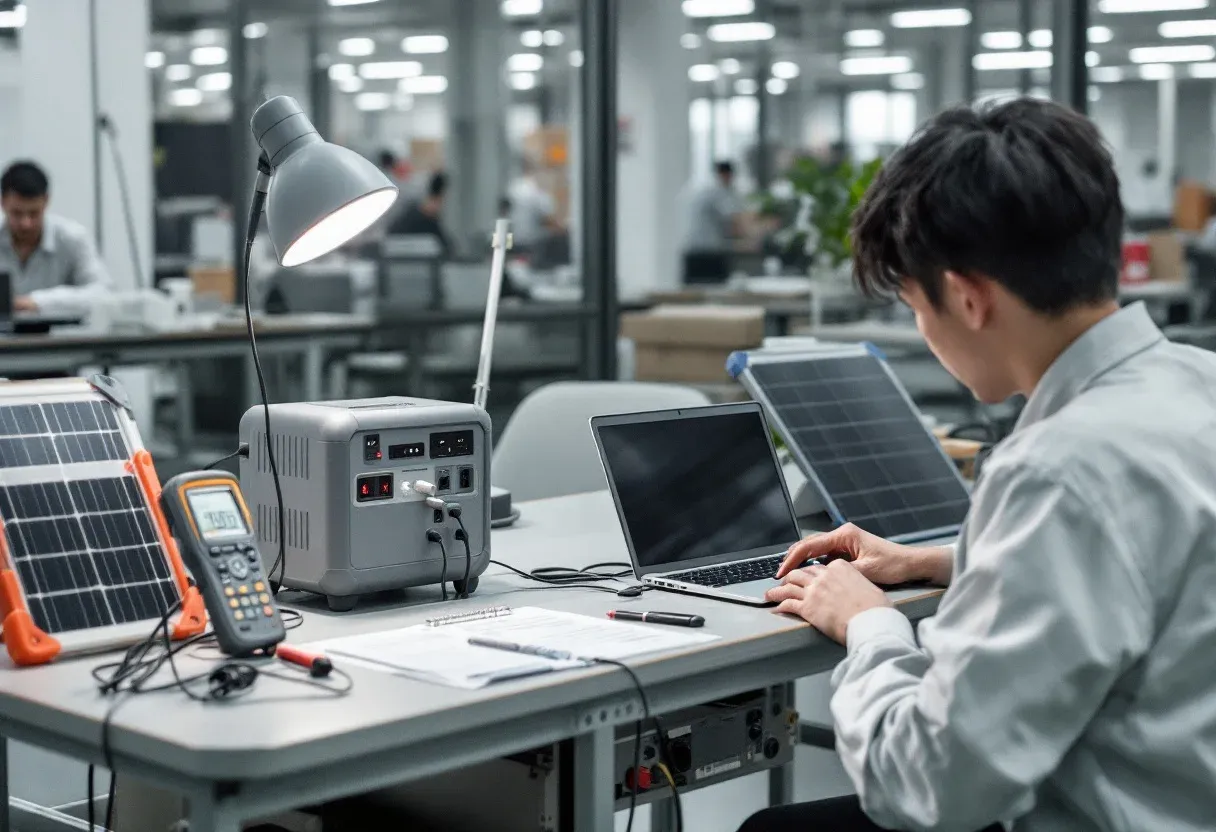
| Charging | Mains, car and solar input; matching folding solar panels available |
| Checks | Sample capacity test against rated Wh, inverter output under load, temperature and protection checks |
What we verify at the factory, before the container is sealed
Goods that fail compliance or pre-shipment QC stay in China at the factory's cost, you do not pay freight on non-compliant product.
Ask about compliance documentation →- UN38.3 transport testing for the battery in each model
- CE: LVD 2014/35/EU and EMC 2014/30/EU, with safety test reports (for example IEC 62368-1 and IEC 62133); RED 2014/53/EU where the unit has app control
- EU Battery Regulation (EU) 2023/1542 labelling and producer obligations
- WEEE and battery producer registration for the importer of record in each market
- Selling outside the EU? We match the paperwork to your market: CE or UKCA plus PSTI for the UK, FCC for the US, ISED for Canada, RCM for Australia, TDRA for the UAE, and ICASA or NRCS for South Africa
What this lands at, delivered to you
Own-brand and factory-brand power stations cost far less than the big consumer brands for the same rated capacity, but rated capacity is where weak factories cut corners, so we test it. Larger units ship as dangerous goods. We quote landed cost to your country including freight, duty and import VAT or GST.
Lead time and logistics
Lead time: Stock models 1–2 weeks; own-brand packaging 3–5 weeks; then sea freight as dangerous goods.
Power stations ship as lithium-battery dangerous goods (UN3480 or UN3481, depending on how the model is classified) with the right declaration, usually by sea on pallets. Folding solar panels ship as general cargo in the same container.
Import rules for where you sell
Tax, duty and certification differ by country. Each market page sets out what applies, with sources, and how we check it before you pay.
Electronics, sourcing questions answered
Something not covered here? Ask the team →
LiFePO4 or NMC: which should I stock?
For most buyers, LiFePO4. It lasts many more charge cycles and is more thermally stable, which matters for a product people keep in their house or van. NMC units are lighter for the same capacity, so they still suit some compact camping models.
How do you check the capacity is real?
We test samples by discharging them under load and measuring the usable energy against the rated Wh. Factories whose units come in well short of their rating do not make the shortlist.
Can I sell power stations under my own brand?
Yes. Shenzhen factories routinely supply own-brand units with your logo, colours, packaging and manuals. Own-brand raises the minimum order, and you become responsible for compliance as the brand owner, so we make sure the test reports are in order before your name goes on the box.
Get factory-direct pricing on portable power stations
Send a brief, specification, quantity, timeline. We come back with factory-level pricing, a supplier shortlist, and a clear plan. No obligation.