
Phone replacement screens, tested in Shenzhen before they ship to Ireland
Screens are the repair that pays the rent. One repair-industry dataset put screen damage at around 70% of all phone repairs, and most shop owners we speak to see a similar split. Ériu Sourcing buys replacement screens for iPhone and Samsung in Shenzhen's Huaqiangbei parts market and from the panel and assembly factories behind it, then tests every screen before it is packed for Ireland.
Last reviewed:
- Guangdong Manufacturing region
- 1–2 weeks To Ireland by air, in-stock models
- EN + CE Compliance verified at factory
Guangdong (Shenzhen, Huaqiangbei parts market)
Most of the replacement screens sold by European parts distributors start in Shenzhen. The same grade can come from a dozen stalls at very different quality levels, and grade names are not standardised. Buying on the ground, testing before payment and rejecting weak batches is what separates a good parts supply from a returns problem.
See our full China network →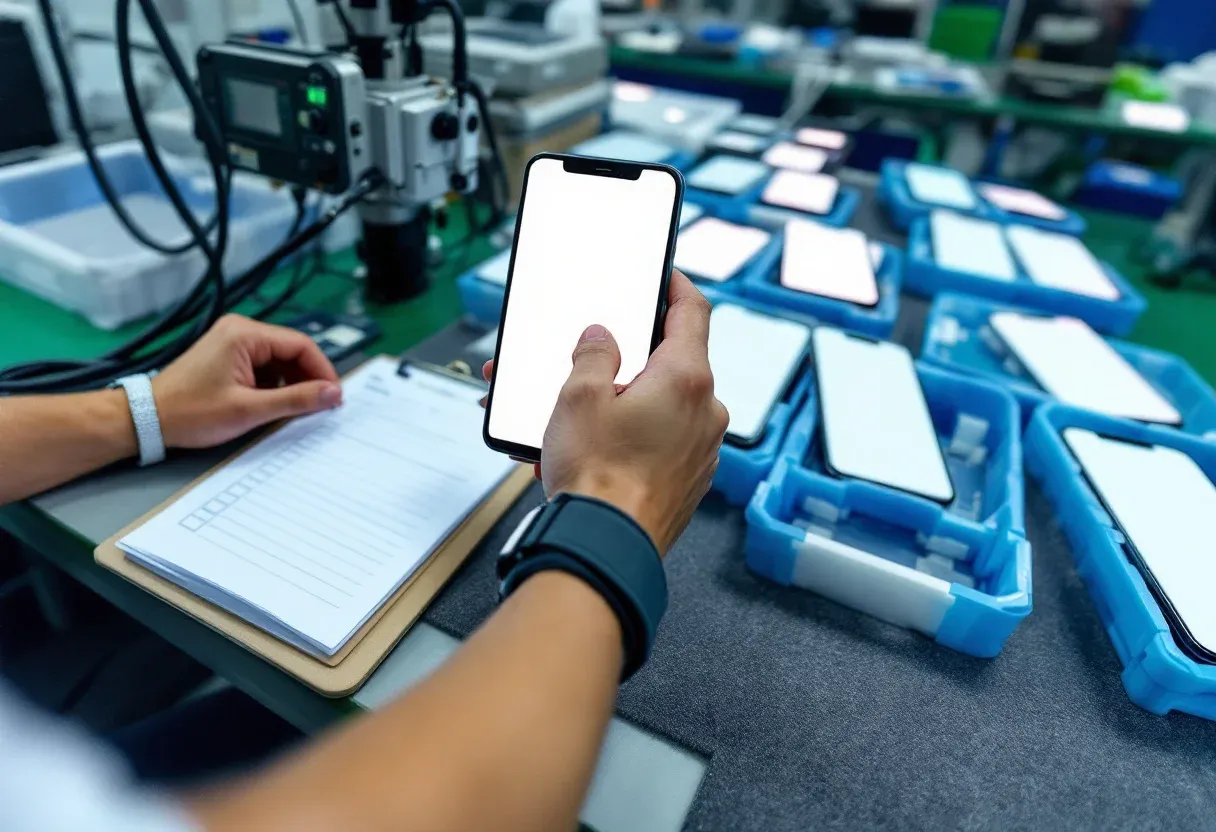
Built for Irish trade buyers, not consumers
- ✓ Independent phone repair shops
- ✓ Phone shops adding repairs to sales
- ✓ Multi-branch repair chains
- ✓ Refurbishers and trade-in businesses
- ✓ Insurance and warranty repair partners
Technical specification
| Brands covered | iPhone (all current and recent models) and Samsung Galaxy S and A series; other Android models on request |
|---|---|
| Grades | In-cell LCD, hard OLED, soft OLED, and genuine pulled or refurbished originals, each labelled clearly by grade |
| Assembly | Complete display assemblies with frame where available, or panel only, to your spec |
| Per-screen test | Display on, dead pixels, colour and brightness uniformity, full touch-grid test, Face ID/proximity flex fit and frame fit |
| Packing | Individually protected in anti-static trays, labelled by model and grade, batch traceable |
| Order format | Mixed orders across models and grades |
What we verify at the factory, before the container is sealed
- No logo-copied or counterfeit-branded parts: aftermarket screens are sold as compatible ("for iPhone 13"), genuine pulls are described as genuine pulls
- RoHS 2011/65/EU material declarations requested from panel suppliers
- Grade, source and test result recorded per batch so warranty claims can be traced back
- Customers are told in writing which grade is in their phone, in line with Irish consumer law
Goods that fail compliance or pre-shipment QC stay in China at the factory's cost, you do not pay freight on non-compliant product.
Ask about compliance documentation →What this lands at in Ireland
Screen prices move with grade more than anything else. Genuine pulled OLEDs cost the most, soft OLED sits a step below, hard OLED below that and in-cell LCD is the budget option. Buying in Shenzhen removes the European distributor's margin, and testing before shipment removes the cost of returns. We quote by model and grade for your actual mix, with landed cost including freight, duty and 23% VAT.
Lead time and logistics
Lead time: Common models are usually in stock in Shenzhen; tested and packed within days, then roughly one to two weeks to Ireland by air express.
Screens ship by air express, boxed in anti-static trays inside rigid cartons to stop pressure damage. Each shipment carries a packing list by model and grade and the per-screen test record.
What Irish buyers need to know
Screens are usually the biggest line on a phone shop's parts bill, so the grade you fit matters more than any other buying decision. If you are weighing up in-cell against OLED, read our guide to phone screen grades, explained for repair shops.
Most shops order screens together with batteries, small parts and accessories on one consolidated shipment. See how that works on our phone repair parts service for Irish shops.
Electronics, sourcing questions answered
What is the difference between in-cell, hard OLED and soft OLED replacement screens?
In-cell is an LCD with the touch layer built in. It is the cheapest option, but it is thicker and its colour and battery draw do not match an OLED original. Hard OLED is a real OLED panel on a rigid glass base: good colour at a mid price, but it tolerates frame flex less well. Soft OLED is built on a flexible base like the original and is the premium aftermarket tier. Genuine pulled screens are original panels taken from donor phones and graded on cosmetic condition.
Will a replacement screen show a warning on the iPhone?
On recent iPhones, a screen that is not a new genuine Apple part will show a notice in Settings, and Apple describes "Unknown Part" and "Used" messages on its support pages. The phone keeps working. True Tone and auto-brightness behaviour depends on the screen and the iOS version, so we test current stock against the current iOS release and tell you what to expect for each grade before you order.
How do you check the screens before they ship?
Every screen is powered up and checked for dead pixels, colour and brightness uniformity and a full touch-grid response, and its frame and connectors are checked for fit. Failed screens are rejected in Shenzhen, not shipped to you. You receive the test record with the packing list.
Can I order a mix of models and grades?
Yes. Phone shops need a spread, not a pallet of one model. We build mixed orders across iPhone and Samsung models and grades, with first orders typically from around €3,000. We quote landed cost for the exact mix you send us.
Related products you can source direct
- Phone replacement batteries
- Charging ports
- Phone accessories for Irish phone shops
- Smartwatches and wearables for Irish phone shops
- Action cameras and wearable cameras
- Wholesale refurbished phones
- Home battery storage for Irish installers
- Portable power stations
Get factory-direct pricing for phone replacement screens, tested in shenzhen before they ship to ireland
Send a brief, specification, quantity, timeline. We come back with factory-level pricing, a supplier shortlist, and a clear plan. No obligation.