
PIR insulated sandwich panels, wall and roof, factory-direct from China to Ireland
PIR (polyisocyanurate) insulated sandwich panels are the standard envelope for cold-storage facilities, industrial sheds, agricultural buildings, and increasingly for modular and container construction. Ériu Sourcing sources EN 14509-compliant PIR panels direct from Chinese panel manufacturers for Irish industrial contractors and modular builders.
Last reviewed:
- Jiangsu and Hebei Manufacturing region
- 4–6 weeks production Production lead time
- EN + CE Compliance verified at factory
Jiangsu and Hebei Provinces
China's sandwich panel industry is concentrated in Jiangsu (around Wuxi) and Hebei (around Cangzhou), close to the largest steel coil mills. The combination of coil supply and continuous-line PIR foaming plants delivers panel pricing that European panel brands cannot match, even after sea freight to Dublin.
See our full China network →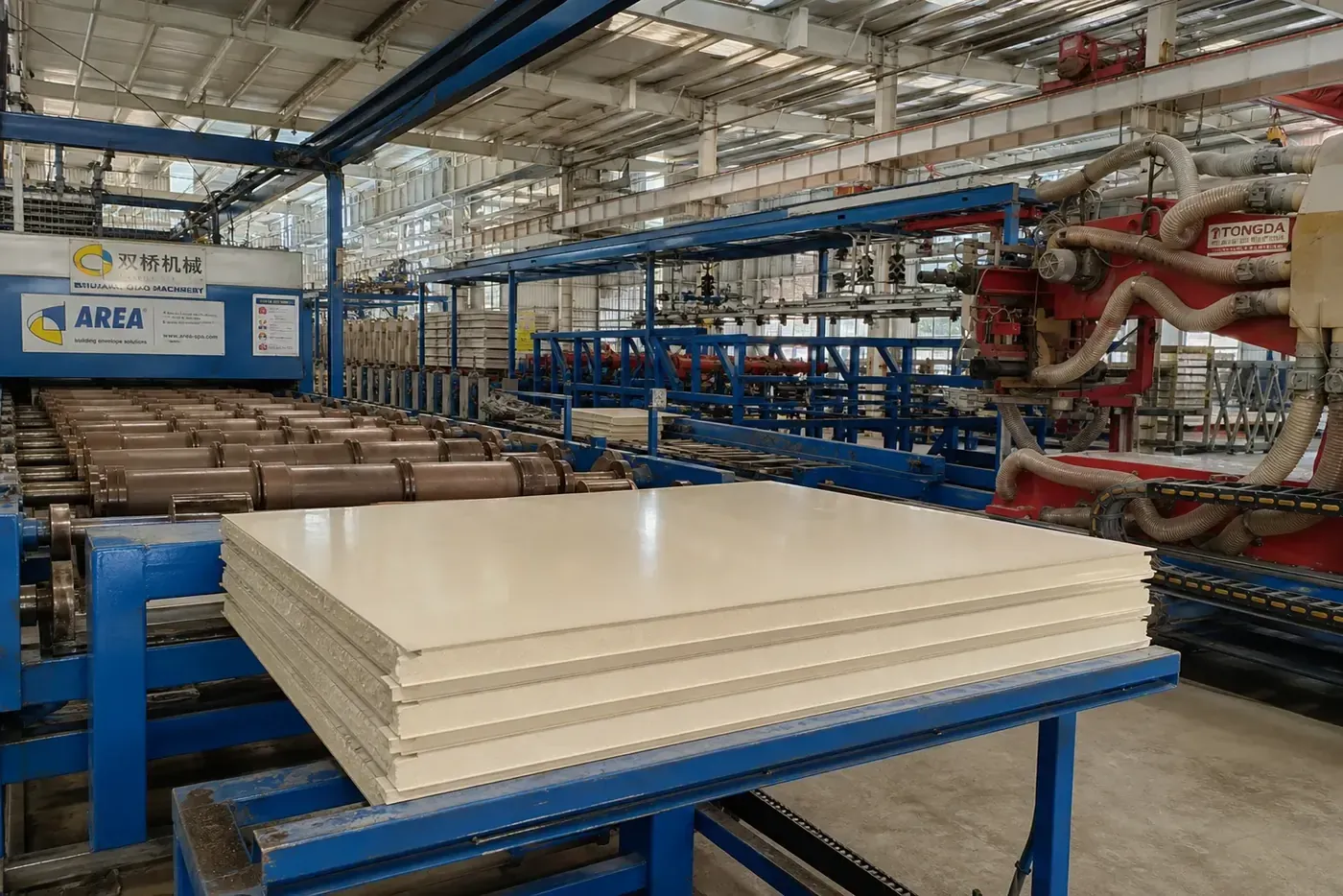
Built for Irish trade buyers, not consumers
- ✓ Irish industrial and warehouse contractors
- ✓ Cold-storage and food-processing facility builders
- ✓ Agricultural building installers
- ✓ Modular and container home manufacturers
- ✓ Self-build and rural commercial projects
Technical specification
| Core | PIR (polyisocyanurate), density 38–42 kg/m³ |
|---|---|
| Panel thickness | 50, 75,100,120,150,200 mm |
| Facings | 0.4–0.6 mm pre-painted galvanised steel (PPGI), RAL colour |
| Panel width | 1000 mm (standard module), 1150 mm available |
| Panel length | Cut-to-length up to 12 m (containerisable) |
| Thermal performance | λ ≈ 0.022 W/mK; U-value 0.21 W/m²K @ 100 mm; 0.11 W/m²K @ 200 mm |
| Fire rating | Reaction-to-fire B-s2, d0 (PIR); fire resistance EI 30 / EI 60 available |
What we verify at the factory, before the container is sealed
- EN 14509, Self-supporting double-skin metal-faced insulating panels (product standard)
- EN 13501-1, Reaction-to-fire classification (B-s2, d0 for PIR)
- EN 1364-1 / EN 1365-2, Fire resistance testing (where EI rating required)
- CE marking + Declaration of Performance per CPR (EU) 305/2011
- FM Approvals, available on specific panel lines for insurance-rated cold storage
Goods that fail compliance or pre-shipment QC stay in China at the factory's cost, you do not pay freight on non-compliant product.
Ask about compliance documentation →What this lands at in Ireland
PIR wall and roof panels from Chinese factories typically land in Ireland 30–45% below quotes from Kingspan, Isopan, or Paroc trade dealers for equivalent thickness and fire rating, after EU import duty, sea freight, and customs. The saving widens on larger orders and on thicker panels (150 mm+) where Irish trade pricing carries a steep uplift.
Lead time and logistics
Lead time: 4–6 weeks production + 4–5 weeks sea freight (Shanghai/Ningbo → Dublin).
Panels ship in custom wooden crates, length-restricted to 12 m for 40ft HQ container loading. A 40ft HQ container holds approximately 350–450 m² of 100 mm panel. Heavier orders (multiple containers, longer panels) ship break-bulk or in 40ft open-top with tarpaulin. Ériu Sourcing coordinates Dublin Port clearance and onward HIAB delivery to site.
Construction Materials, sourcing questions answered
Are PIR sandwich panels from China CE-compliant for use in Ireland?
Yes, when sourced from a factory producing to EN 14509. The Declaration of Performance must reference the harmonised standard, declare the reaction-to-fire class (B-s2, d0 for PIR), thermal conductivity, panel geometry, and where required, fire resistance (EI 30/60). Ériu Sourcing audits the factory's test reports and DoP before quoting, Chinese-issued certificates without EN 14509 traceability are rejected.
What thickness do I need for cold storage versus general industrial use?
Typical cold-storage envelopes use 100–150 mm PIR for chill (0–5°C) and 150–200 mm for freezer (-18 to -25°C). General industrial wall use is commonly 75–100 mm; roof use 100–120 mm. For Irish Building Regs Part L compliance in commercial buildings, 120 mm or thicker is typically required on warm-roof and wall applications.
Can I order panels cut to specific lengths for a modular building?
Yes. Chinese factories cut to length on the continuous line, typical maximum is 12 m to fit a 40ft HQ container. Length tolerance is ±5 mm. For modular and container-home applications, panels can be supplied with pre-cut window and door openings if working drawings are provided, though most builders prefer to cut openings on site.
What is the difference between PIR, PUR, and EPS panels?
PIR (polyisocyanurate) is the standard fire-performing rigid insulation for sandwich panels, λ ≈ 0.022 W/mK, reaction-to-fire B-s2, d0. PUR (polyurethane) has similar thermal performance but lower fire performance (typically D-s3, d0). EPS (expanded polystyrene) is cheaper but worse on both thermal (λ ≈ 0.036) and fire (E-class). For Irish commercial and cold-storage applications, PIR is the default specification.
How is panel quality verified before shipment?
Ériu Sourcing books a factory inspection covering: facing-steel gauge and coating thickness (micrometer-measured), core density (cut-and-weigh on a sample panel), bond integrity (peel test), panel geometry (length, width, squareness), and full review of the EN 14509 test pack and DoP. Inspection report and photos are issued before container sealing, defective batches stay in China.
Related products you can source direct
- Commercial LED lighting
- Sanitaryware
- Aluminium composite panels (ACP)
- Construction fasteners and fixings
- WPC composite fencing
- Decorative interior wall panels
- Epoxy resin flooring systems
- SPC / LVT rigid-core flooring
Get factory-direct pricing for pir insulated sandwich panels, wall and roof, factory-direct from china to ireland
Send a brief, specification, quantity, timeline. We come back with factory-level pricing, a supplier shortlist, and a clear plan. No obligation.