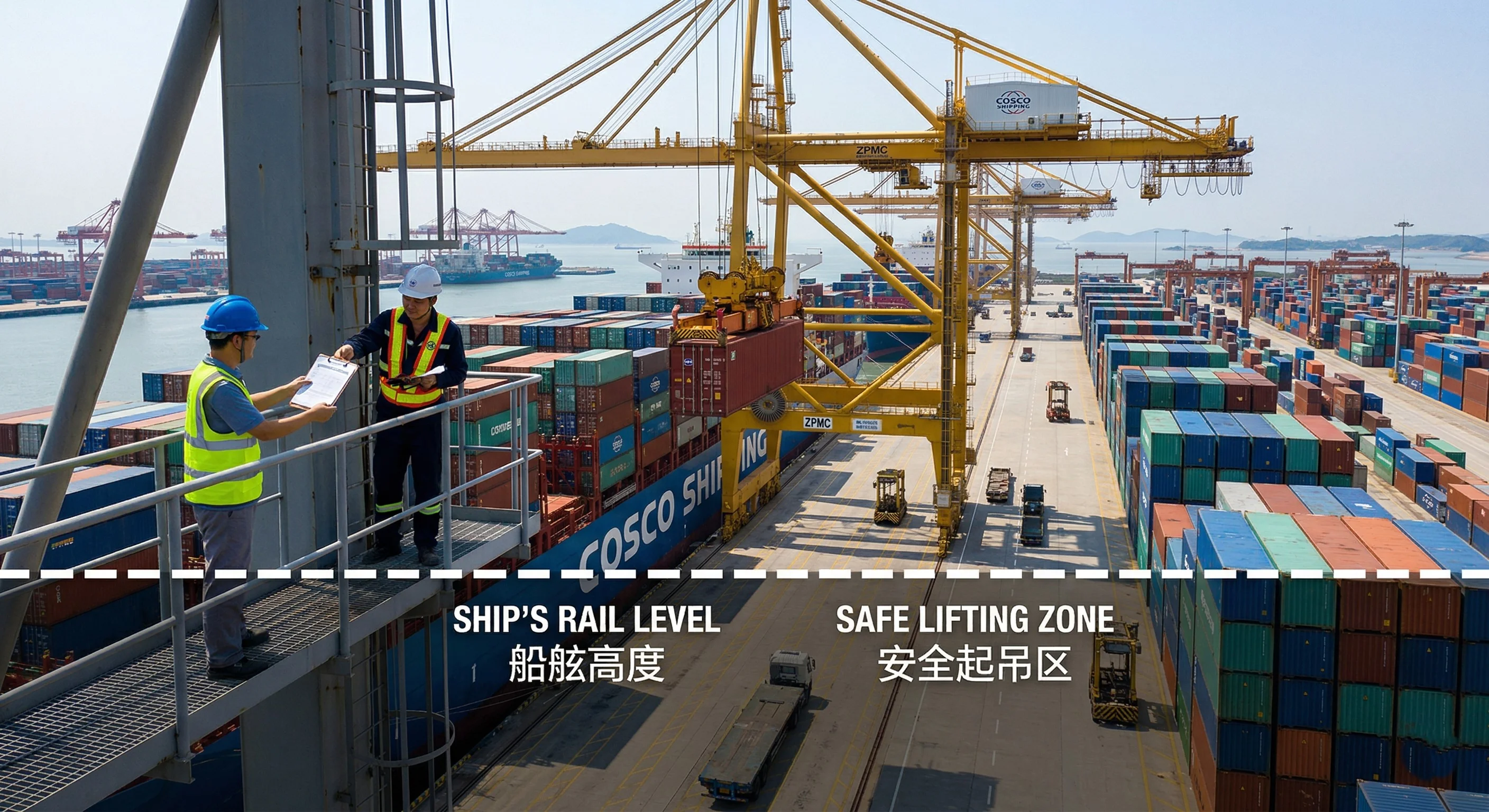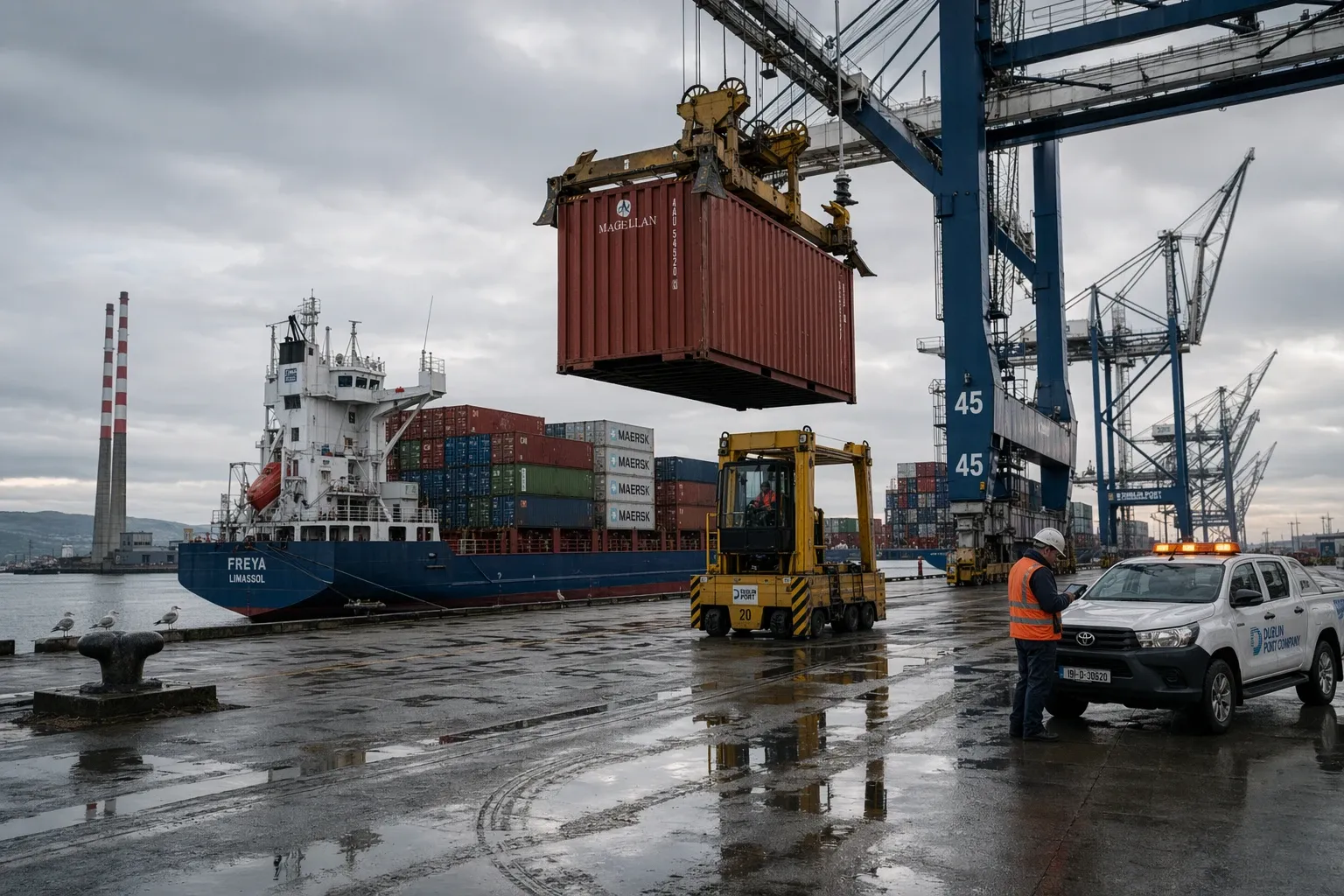
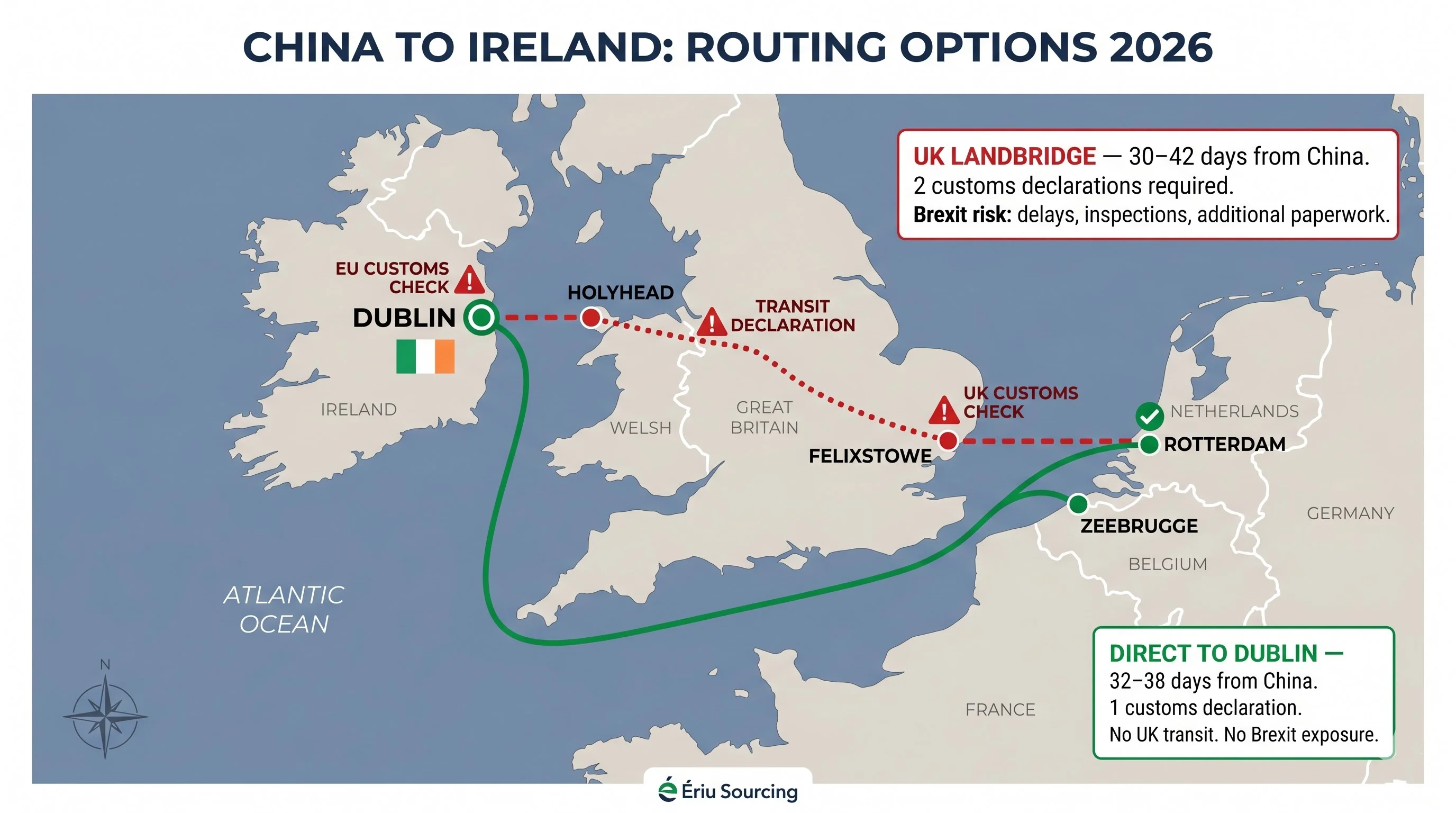
The logistics of moving a shipping container from Shenzhen to Dublin shifted permanently following Brexit. For decades, the default route involved transshipping through massive UK ports like Felixstowe or Southampton, running the goods across the UK on trucks, and ferrying them across the Irish Sea via the "landbridge."
Today, moving goods bound for the Republic of Ireland through the UK customs jurisdiction is a bureaucratic liability. Irish importers now overwhelmingly bypass the UK, relying on direct maritime routes originating from continental European hubs like Rotterdam, Antwerp, or Le Havre, sailing directly into Dublin, Cork, or Rosslare.
Understanding this new geography is critical to forecasting your transit times. However, the physical shipping route is only part of the challenge. The paperwork, clearing Irish customs, correctly classifying Harmonised System (HS) codes, and managing import VAT, is where most first-time importers experience expensive delays.
This guide explains exactly how freight moves from China to Ireland in 2026, the documents you absolutely must have, and how to navigate the Revenue process without delays.
Sea Freight: FCL vs LCL and Route Fundamentals
Sea freight is the economic engine of China sourcing. Ocean transit takes between 30 and 42 days, depending on the origin port and the specific carrier routing.
Irish businesses operate within two sea freight modes: FCL (Full Container Load) and LCL (Less than Container Load).
FCL means you are renting the entire 20-foot, 40-foot, or 40-foot High-Cube container. Once your goods are loaded at the factory in China, the doors are sealed, and they are not opened again until the container backs up to your warehouse dock in Ireland. FCL is the most secure, fastest, and most cost-effective way to ship volume. Generally, if your order is larger than 15 cubic metres (CBM), buying a 20-foot FCL is cheaper than paying shared cargo rates.
LCL means you are sharing a container with other importers. Your goods are consolidated into a container at a Chinese port warehouse, shipped to Europe, and then deconsolidated at a warehouse before final delivery. LCL is perfect for smaller orders (2 CBM to 15 CBM), but it adds 5 to 10 days to the transit time due to the consolidation and deconsolidation handling.
The Post-Brexit Route: The vast majority of China-to-Ireland sea freight is now routed on massive mother vessels from Shanghai, Ningbo, or Shenzhen to European hub ports (typically Rotterdam in the Netherlands). From Rotterdam, the containers are loaded onto smaller "feeder" vessels that sail directly across the Celtic Sea into Dublin or Cork ports. This bypasses UK customs completely, avoiding transit declarations and potential double-duty exposure.
Air Freight and Rail Freight
Air Freight from China to Dublin (often routed through DUB or occasionally Shannon) takes 5 to 8 days door-to-door. It is extremely reliable but exorbitantly expensive, often 5 to 10 times the price of sea freight per kilogram. Air freight is calculated on "chargeable weight, " which means you pay for whichever is greater: the actual weight of the goods, or the volumetric weight (the space the box takes up). It is only commercially viable for high-margin electronics, urgent samples, or late seasonal stock that missed the sea freight cutoff.
Rail freight has emerged as a middle ground via the "New Silk Road." Goods travel by rail from China, across Russia/Central Asia, into Germany or Poland, and are then trucked across Europe and ferried directly into Ireland. It offers transit times of roughly 22 to 26 days, faster than the sea, slower than the air, at a price point right in between. However, geopolitical friction in Eastern Europe has occasionally disrupted these routes, so your freight forwarder must advise on current viability.
The Freight Forwarder: Your Most Important Partner
A freight forwarder is a travel agent for cargo. They do not own the ships or the planes. They own the network. A professional Irish freight forwarder will book the vessel space with carriers (like Maersk or MSC), coordinate the trucking in China, arrange the marine insurance, and seamlessly handle the Irish customs declarations upon arrival.
As outlined in our Incoterms guide, Irish businesses should heavily favour purchasing on FOB (Free On Board) terms. Under FOB, your supplier handles the Chinese logistics locally, and your Irish freight forwarder takes control of the cargo the moment it is loaded onto the ship. This gives you local Irish accountability. If the ship is delayed, you call a logistics expert in Dublin, not an overworked factory rep in Shenzhen.
Customs Clearance in Ireland: The Required Bureaucracy
Clearing Irish customs via Revenue.ie is a strict, documentation-heavy process. You cannot improvise here. Missing paperwork means the container sits in a bonded warehouse at Dublin Port incurring daily "demurrage" (storage) fees until the paperwork is corrected.
Before you ship anything, your business must have an EORI Number (Economic Operators Registration and Identification). It is legally required to import goods from outside the EU. You can register for this via your Revenue Online Service (ROS) account; it is usually tied to your VAT number and takes just a few days to issue.
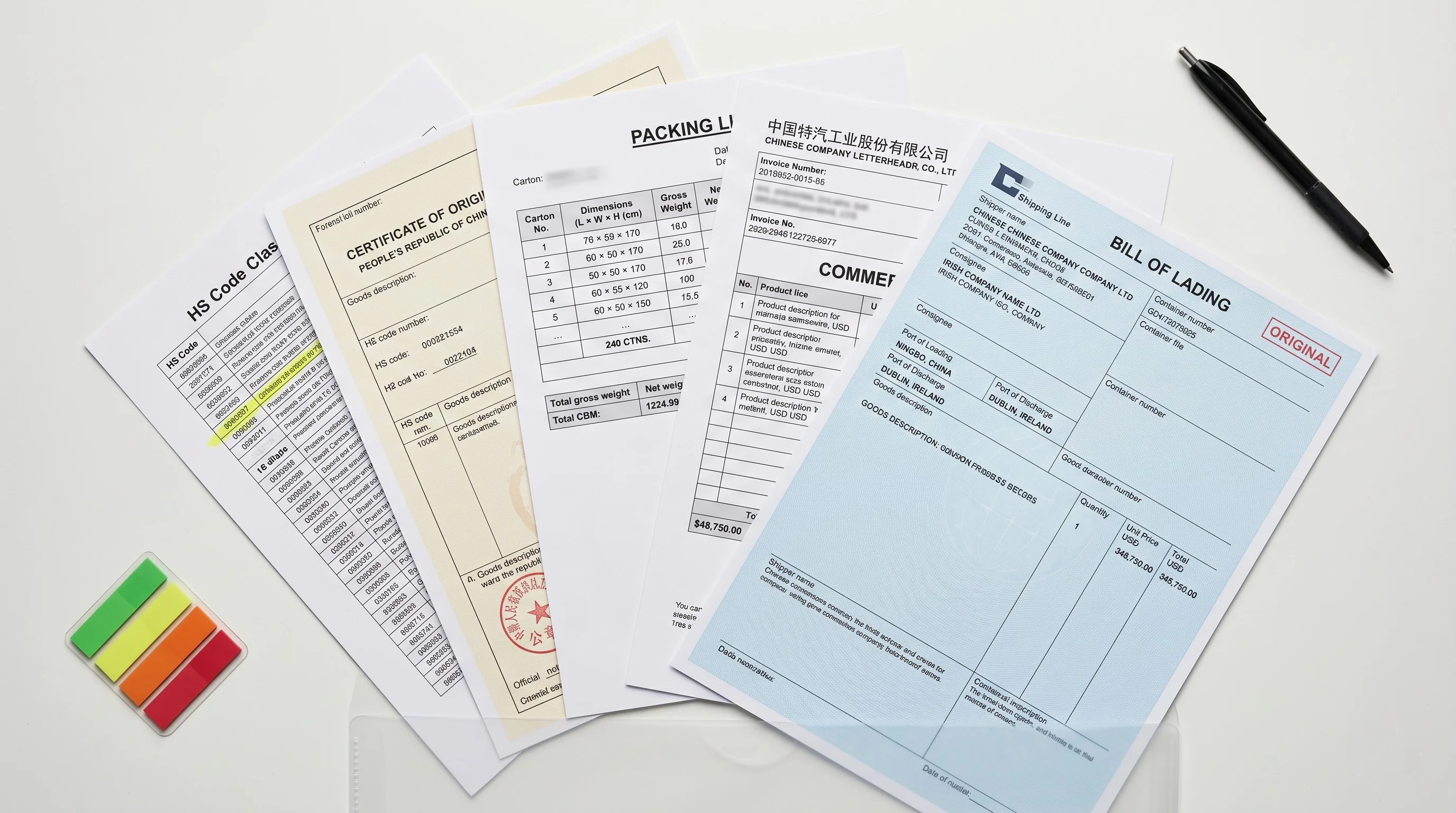
When the shipment arrives, your customs broker (usually supplied by your freight forwarder) will submit an import declaration. To do this, they require four non-negotiable documents from your Chinese supplier:
1. Commercial Invoice: The definitive receipt. It must detail the exact value of the goods, the currency, the Incoterms agreed upon (e.g., FOB Shenzhen), and a clear description of the items.
2. Packing List: A highly detailed breakdown of how the goods are packed. It must outline the number of cartons, the gross weight, the net weight, and the dimensions of the pallets. Customs officers use this to verify the physical shipment.
3. Bill of Lading (B/L): The title deed to the cargo. Issued by the shipping line, it proves the goods have been loaded. Often handled digitally today via a "Telex Release, " meaning you don't need physical couriered paper to claim your goods.
4. Compliance Documentation: If importing regulated goods, electronics, toys, machinery, the EU Declaration of Conformity and CE test reports must be available. Customs may demand to see them before releasing the container.
HS Codes and Postponed VAT Accounting (PVA)
Irish Customs charges duty based on the 10-digit Harmonised System (HS) code classification of your product. This code defines precisely what the item is and applies the correct tariff rate (determined by the EU TARIC database). A wooden chair faces a different duty percentage than an upholstered chair. Deliberately misclassifying an HS code to secure a lower duty rate is customs fraud and carries severe penalties.
Import VAT is then applied at the standard Irish rate (currently 23 per cent) across the total "Customs Value", which is the value of the goods, PLUS the shipping cost, PLUS the customs duty.
However, the cash flow burden of paying massive VAT bills at the port has been resolved for VAT-registered Irish businesses. Postponed VAT Accounting (PVA) allows you to declare the import VAT on your bi-monthly VAT return rather than paying it physically at the harbor. By simultaneously declaring it as a liability and an input credit on the same return, the cash flow impact is neutralised. Ensure your customs broker knows you want to utilize PVA.
Summary
The 2026 Ireland logistics pipeline from China is highly mature, but strictly unforgiving of amateur mistakes. Use FOB terms to control your costs, partner with an experienced Irish freight forwarder who uses direct European routing, register your EORI number early, and demand precise commercial documents from the factory.
At Ériu Sourcing, we specialize in bridging the gap between the factory floor in China and the warehouse door in Ireland. We coordinate with elite freight forwarders to ensure goods are shipped cost-effectively and clear customs smoothly. If you require an end-to-end sourcing and logistics solution, speak to us today.
Frequently asked questions
Do goods from China to Ireland still incur UK customs delays after Brexit?
Minimal to none. Most professional freight forwarders now route Irish ocean freight via direct feeder services from European hubs (like Rotterdam or Antwerp) straight into Dublin or Cork, entirely bypassing the UK "landbridge" and avoiding transit declaration complexities.
What paperwork do I need to clear an import through Irish Customs?
You need an active EORI number, a Commercial Invoice detailing the exact value and HS codes, a detailed Packing List, the Bill of Lading from the carrier, and any relevant compliance documents (like CE Declarations of Conformity for electronics).
Do I have to pay 23% VAT upfront at Dublin Port before my goods are released?
If you are a VAT-registered business in Ireland, no. You can use Postponed VAT Accounting (PVA) to account for the import VAT on your standard VAT-3 return, allowing you to neutralize the cash flow impact immediately.