
What you actually save by going inland.
For two decades the default was the coast. But rising wages, land and taxes in the Pearl River and Yangtze deltas have made central China a serious alternative for cost-sensitive production. Here is the honest comparison, where Henan wins, where the coast still wins, and how to decide.
Manufacturing has been moving inland for years
This is not a pitch; it is a documented trend. As coastal regions became more expensive, higher wages, dearer land, heavier overhead, China's six central provinces (Anhui, Henan, Hubei, Jiangxi, Hunan and Shanxi) actively courted cost-sensitive production. For many foreign investors, moving inland has become an alternative to relocating offshore entirely.
What makes Henan different from a generic "cheaper inland" story is that the cost saving does not come with isolation. Zhengzhou's Tier-1 air-cargo hub and China–Europe rail node mean you keep fast access to European and Eurasian markets while paying inland prices for land and labour.
See the logistics that make this work →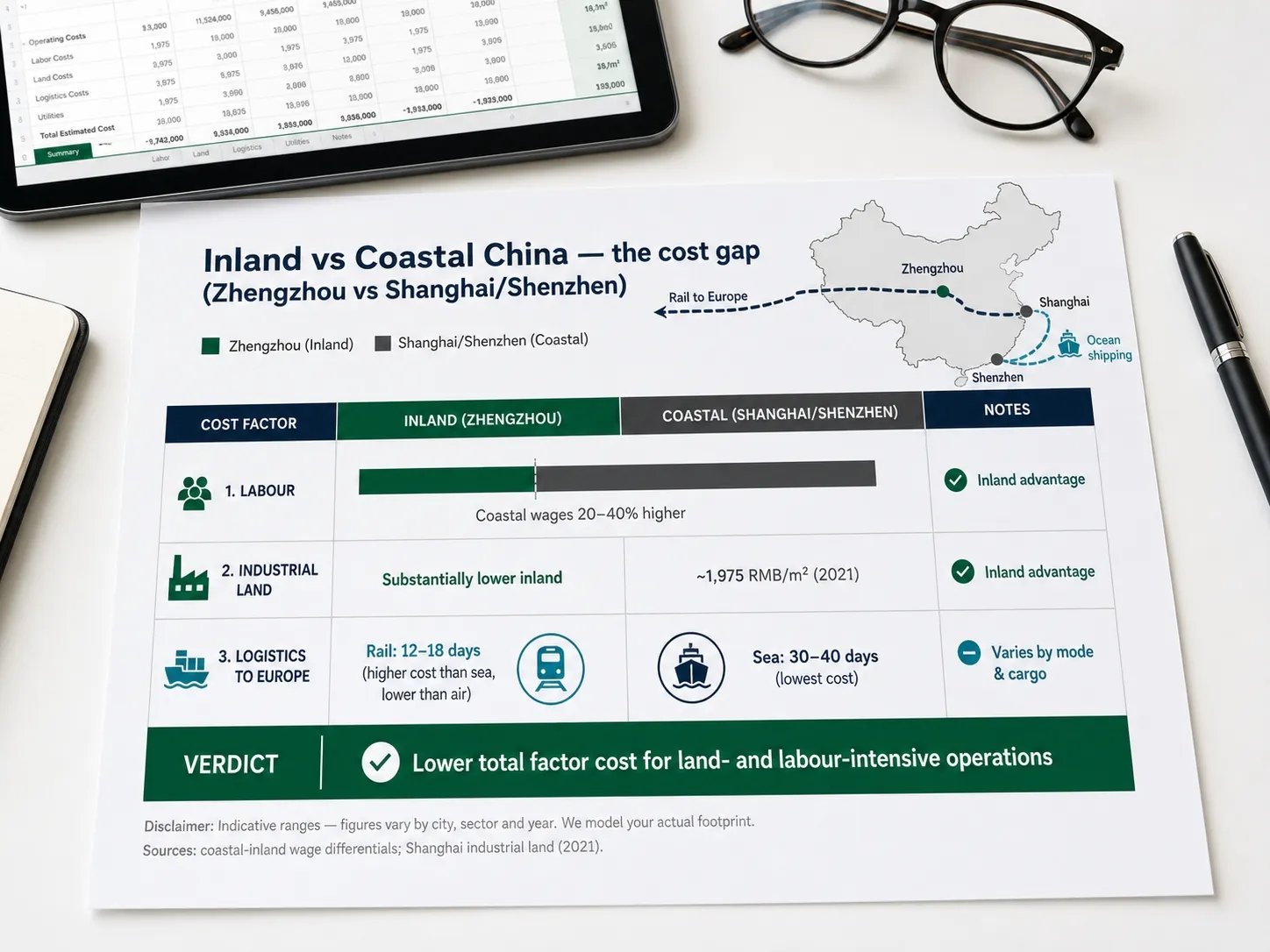
Inland vs coastal, where each wins
Cost is not one number. Here is how the main factors compare, and an honest verdict on each, including the ones where the coast is still the better answer.
Land and wage figures are indicative and dated where noted (e.g. Shanghai industrial land ~1,975 RMB/m², 2021); actual costs vary by city, district, sector and year. We model your specific operation rather than rely on a blanket percentage.
Labour and land, where the gap is real
Labour. Wages in the major coastal cities, Shanghai, Shenzhen, Guangzhou, typically run 20–40% higher than in inland provinces such as Henan. For labour-intensive assembly and processing, that differential compounds across a full workforce and a full year into a material number. Henan also offers a large, comparatively stable labour pool, part of why Foxconn runs its biggest iPhone operation here.
Land. The gap is even starker on industrial land. Shanghai industrial land has been reported around 1,975 RMB/m² (2021), with other top-tier coastal cities in a similar band, while inland industrial land sits far below that, and key zones in Henan add land-use guarantees for qualifying projects. For land-intensive operations, large plants, warehousing, processing lines, that is often the single biggest saving.
The honest caveat: published land and wage figures move year to year and vary widely by district and sector. Treat them as direction, not precision, and model your own footprint before deciding.
What the coast still does better
A comparison that only listed advantages would not be worth trusting. The coast keeps genuine edges: supplier density in specific categories (consumer electronics around Shenzhen, furniture around Foshan), deeper pools of specialist engineering talent, and direct deep-sea port access. For some highly specialised supply chains, those outweigh the inland cost saving.
So the real answer is rarely "all-in on one coast or one inland city." It is a considered split: base cost- and logistics-led operations inland in Zhengzhou, while keeping coastal sourcing where the cluster depth genuinely matters. That is exactly the dual-base model we run ourselves, Zhengzhou and Shenzhen, and it is why we can give you a straight answer about which categories belong where.
See our dual-base setup →Inland vs coastal cost, questions answered
Last reviewed: June 2026
Is manufacturing in Henan cheaper than coastal China?
Generally yes, on total factor cost. Coastal wages (Shanghai, Shenzhen, Guangzhou) are typically 20–40% higher than inland provinces like Henan, and industrial land is dramatically cheaper inland, Shanghai industrial land has been reported around 1,975 RMB/m² (2021) against far lower inland levels. Land and labour are where central provinces win most clearly.
Why is manufacturing moving from the coast to central China?
Rising wages, land prices and taxes on the coast have pushed cost-sensitive production inland. China's six central provinces, Anhui, Henan, Hubei, Jiangxi, Hunan and Shanxi, have actively courted that demand. Henan stands out because it pairs lower costs with a Tier-1 air-cargo hub and a China–Europe rail node, so you are not trading cost for isolation.
What do you give up by basing inland instead of on the coast?
A few things, honestly: the coast still has unmatched supplier density in certain categories (electronics around Shenzhen, furniture around Foshan), deeper specialist engineering talent, and direct deep-sea port access. For some specialised supply chains those outweigh the cost gap. Zhengzhou is strongest for land- and labour-intensive operations, logistics-led businesses, and Henan's own cluster categories, so the right answer is often a considered split, not a blanket choice.
Explore the Zhengzhou cluster
Want the real number for your operation?
A blanket percentage is useless. Tell us your footprint, headcount, land, throughput, freight, and we'll model inland vs coastal on total cost of ownership, not a headline.